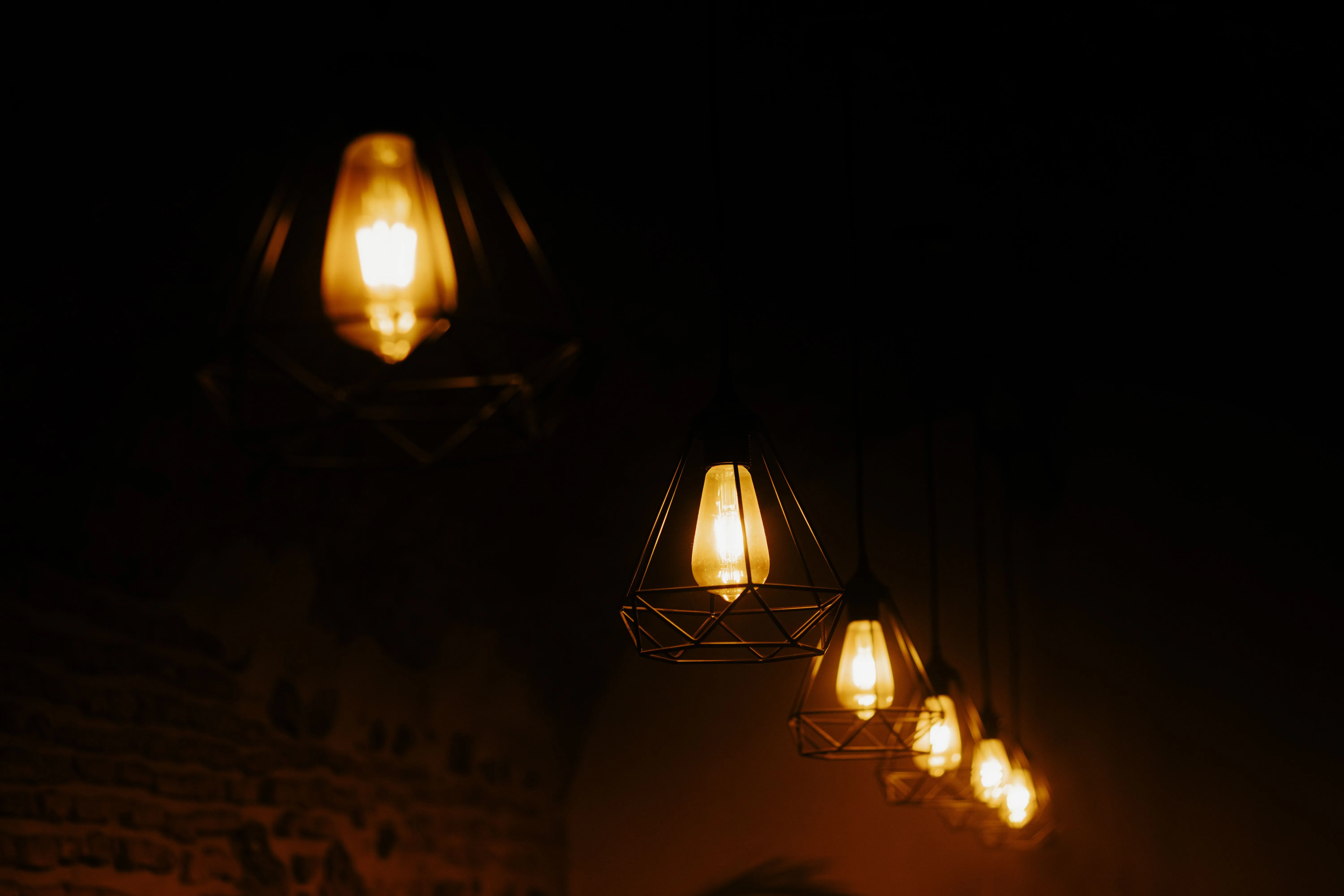

Lighting is the electrical work people notice every single day, and the work most often done to whatever was cheapest at the time. We install and replace interior fixtures, recessed lighting, under-cabinet and task lighting, exterior and security lighting, and landscape lighting — for homes and businesses in Nashville, Brentwood, Franklin, Belle Meade, Forest Hills, Oak Hill, Bellevue, Mt. Juliet, Goodlettsville, Hendersonville, Gallatin and White House.
Some of it is straightforward replacement. A good deal of it is not: a kitchen lit by one central fixture, a dim stairwell, a workshop with shadows exactly where the work happens, or a parking area where the light lands everywhere except the path people walk. Those are layout problems, and swapping the bulb for a brighter one usually makes them worse.
The lighting work we take on
Interior fixtures, recessed layout, task, exterior and landscape lighting, LED retrofits, switching and controls.
- Fixture replacement, including fixtures in places that make replacement awkward — two-story entry ceilings, stairwells, vaulted rooms — where the work is mostly about access and doing it safely.
- Ceiling fans and fan-and-light fixtures are a related but separate job, because a fan needs a box rated to carry a moving load rather than a standard lighting box — see ceiling fan installation and repair.
- Recessed lighting, new or added to an existing room, including layout: how many, how far apart, how far off the walls, and what beam spread suits the ceiling height. Cans placed by guesswork give you scallops on the walls and a dark middle.
- Under-cabinet, cove and task lighting, where the fix for a dim worktop is light at the work surface rather than more light at the ceiling.
- Exterior and security lighting — soffit, wall pack, flood and motion lighting, with attention to where the light actually falls and to glare into neighboring windows.
- Landscape lighting, including transformers, low-voltage runs and fixtures positioned to light a path or a facade rather than the sky.
- LED retrofits for homes and businesses, including replacing failed ballasts, converting fluorescent troffers, and dealing with the flicker and buzz that appears when a dimmer meets an LED it was never designed for.
- Switching and controls: adding a three-way, correcting a switch loop with no neutral, and matching dimmers to the actual load.
Signs it is time to call
Rooms avoided after dark, flicker or buzz after an LED changeover, repeat bulb failures, heat-marked housings, exterior coverage that has drifted.
- A room you avoid using in the evening.
- Flickering or buzzing after an LED changeover — usually a dimmer incompatibility, sometimes something worse.
- Bulbs in one fixture failing repeatedly. That is a symptom, not a bulb quality problem, and it is worth tracing properly.
- Discolored or heat-damaged fixture housings, particularly older recessed cans in insulated ceilings.
- Exterior lighting that no longer covers where people walk, or that comes on for cars two streets away.
- A commercial space with failing ballasts and a maintenance bill that keeps arriving.
- A renovation, which is the cheapest possible time to reposition lighting, because the ceiling is already open.
How we work through a lighting job
Looking at the room lit and unlit, checking ceiling and switch-box constraints, agreeing a layout before any hole is cut.
We start in the room with the lights on and the lights off, because a description over the phone rarely matches what the room is doing. Where you work, where you sit, where the glare lands, what time of day it matters.
Then we deal with the physical constraints honestly: joist direction, ceiling construction, insulation, what is above the ceiling, and whether the existing switch box has a neutral. These determine what is possible and what it costs, and we would rather say “that layout needs the ceiling opened here” at the estimate than discover it with your furniture under a dust sheet.
For anything beyond a straight swap we agree a layout before we cut a single hole — number of fixtures, spacing, color temperature and dimming — because holes in a ceiling are not a decision you get to revisit cheaply. Then we install, wire, test the dimming across its range, and clean up after ourselves. Where a lighting job needs its own supply, that goes in as a dedicated circuit.
Why Power Line Electrical Contractors
A licensed contractor who will give an opinion on layout, color temperature and fixture fit — and will not push a brand.
Lighting sits between electrical work and design, and the trade tends to treat it as neither. We will give you an opinion — on color temperature, on how many cans a room really needs, on whether that fixture will look absurd at that ceiling height — and we will also tell you when what you have asked for is perfectly fine and needs nothing more than doing properly.
The work is carried out under Tennessee Electrical Contractor #82227, by a licensed, bonded and insured contractor with 25+ years of experience, to current code. Our hours are 5:00 AM to 7:00 PM, seven days a week, and emergency and same-day service is available. Estimates are free.
One thing we will not do is claim a relationship with a fixture manufacturer or push a particular brand. Buy the fixtures you like; we will tell you before installation if a chosen fixture will not do what you are expecting of it.
Request an estimate, or look through the rest of our electrical services.
Lighting Installation FAQs
Why do my recessed lights leave dark spots or scallops on the wall?Why scalloping is a spacing and beam-spread problem that a brighter bulb usually makes worse.
That's a layout problem — cans placed by guesswork rather than planned for spacing, distance from walls and beam spread relative to ceiling height. Swapping in a brighter bulb usually makes it worse rather than better.
Can Power Line Electrical Contractors fix flickering after an LED retrofit?Flicker and buzz after an LED changeover, most often dimmer compatibility, traced rather than guessed.
Usually, yes — flickering or buzzing after an LED changeover is most often a dimmer incompatibility, though occasionally something more serious, and we trace it rather than guess.
Does a new lighting circuit need its own dedicated circuit?Where a lighting job needs its own supply, it goes in as a dedicated circuit.
Where a lighting job needs its own supply, yes — that goes in as a dedicated circuit installed to the same standard as any other circuit we install.